

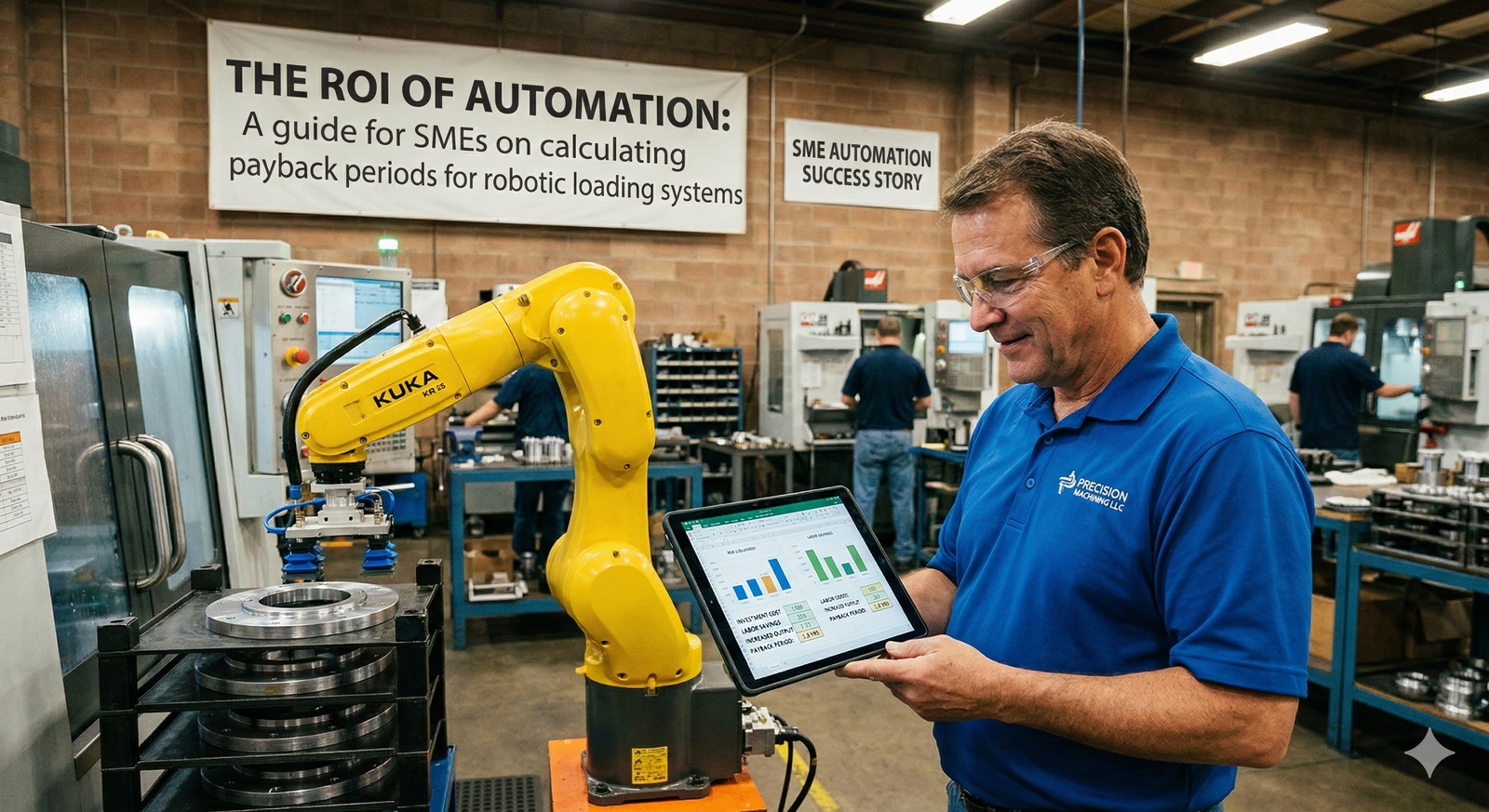

A Practical Guide for SMEs Calculating the Payback Period of Robotic Loading Systems
For many small and mid-sized machine shops, automation used to feel like something only large manufacturers could afford.
Industrial robots were expensive, complex, and often required dedicated automation engineers to operate. But that reality has changed significantly in recent years.
Today, robotic loading systems are becoming increasingly accessible for small and mid-sized manufacturers (SMEs). When implemented correctly, they can dramatically increase machine utilization, reduce labor pressure, and improve production consistency.
The key question most shop owners ask is simple:
“Will the investment pay for itself?”
Understanding the return on investment (ROI) of robotic loading systems helps manufacturers make informed decisions about when automation makes financial sense.
Why Robotic Loading Is Becoming More Common
Many machine shops operate with expensive CNC machines that run only during a single shift. Once operators leave for the day, production stops.
Robotic loading systems change this equation.
By automatically loading and unloading parts, robots allow machines to continue producing parts:
-
- during lunch breaks
- between operator tasks
- overnight or during weekends
Instead of running for 8 hours per day, a machine may run for 16–24 hours per day, dramatically improving asset utilization.
For shops facing labor shortages or growing demand, this additional production capacity can be extremely valuable.
The Real Cost of Idle Machines
A CNC machine represents a major investment.
For example, a machining center costing $250,000–$500,000 generates value only when it is cutting metal.
If that machine operates only during a single shift, its effective utilization might be limited to:
-
- 40 hours per week
- roughly 2,000 hours per year
However, the machine itself is capable of running far more hours.
Automation allows manufacturers to take advantage of that unused capacity without necessarily hiring additional operators.
Understanding the Cost of a Robotic Loading System
The total cost of automation depends on several factors.
A typical robotic loading system for a CNC machine may include:
-
- an industrial robot
- grippers or part handling tools
- safety guarding
- integration with the CNC machine
- programming and installation
For many SME applications, the total cost of a robotic loading cell typically ranges between:
$80,000 and $200,000, depending on complexity.
While this represents a significant investment, the financial return can often be calculated quite clearly.
The Basic ROI Calculation
To estimate the return on investment, manufacturers should consider three primary factors:
-
-
Additional production capacity
-
Labor cost savings
-
improved machine utilization
-
The basic payback formula is:
Payback Period = Automation Investment ÷ Annual Financial Benefit
Let’s examine how this works in practice.
Example: A CNC Lathe With Robotic Loading
Imagine a CNC lathe currently operating one shift per day.
Current operation:
-
- 8 hours per day
- 5 days per week
- 40 hours per week
The shop installs a robotic loading system that allows the machine to run an additional 6 hours unattended each night.
New operation:
-
- 14 hours per day
- 5 days per week
- 70 hours per week
This increases machine utilization by 75 percent.
Calculating Additional Revenue
Suppose the machine generates $120 per hour of production value.
Additional weekly capacity:
30 additional hours × $120/hour = $3,600 per week
Annual additional production value:
$3,600 × 50 weeks = $180,000 per year
Automation Investment Example
If the robotic loading system costs:
$150,000
The payback calculation becomes:
$150,000 ÷ $180,000 ≈ 0.83 years
This means the automation investment could pay for itself in roughly 10 months.
After that point, the additional production capacity continues generating revenue.
Labor Savings and Workforce Flexibility
Automation does not always eliminate jobs, but it often changes how labor is used.
Instead of standing at a machine loading parts repeatedly, operators can focus on higher-value activities such as:
-
-
machine setup
-
programming
-
quality inspection
-
process improvement
-
In many shops, one operator can supervise multiple automated machines simultaneously.
This flexibility becomes particularly valuable in environments where skilled machinists are difficult to recruit.
Additional Benefits Beyond ROI
While financial payback is important, robotic loading systems often provide other advantages as well.
Consistent Part Handling
Robots load parts with consistent positioning, which can improve process stability.
Reduced Operator Fatigue
Manual loading of heavy or repetitive parts can be physically demanding. Automation reduces this strain.
Improved Safety
Robotic systems can reduce human exposure to hazardous machining environments.
More Predictable Production
Automated systems can run longer without interruption, improving delivery reliability.
When Automation Makes the Most Sense
Not every machining operation is suitable for robotic loading.
Automation works best when parts share certain characteristics.
Ideal candidates often include:
-
- repeat production jobs
- moderate to high production volumes
- stable machining processes
- consistent raw material dimensions
Jobs that require frequent setup changes or extensive manual adjustments may be less suitable for full automation.
Starting With the Right Machine Strategy
Automation works best when machines and processes are designed with automation in mind.
Important considerations include:
-
- reliable chip evacuation
- stable workholding systems
- predictable tool life
- accessible machine loading positions
Machines that support automation effectively allow manufacturers to expand production capacity without dramatically increasing complexity.
Automation as a Capacity Multiplier
Many manufacturers assume the only way to increase output is to purchase additional machines.
However, automation often acts as a capacity multiplier.
By extending the productive hours of existing equipment, shops can increase output without expanding their facility footprint.
This approach often delivers a much faster return than simply adding more machines.
The Role of Skilled Machinists
Even in automated environments, skilled machinists remain essential.
Automation handles repetitive tasks, but experienced machinists are still required for:
-
- programming
- setup planning
- troubleshooting
- process optimization
In many cases, automation actually allows skilled machinists to focus on the work that creates the most value.
Final Thoughts
Automation is no longer limited to large manufacturing corporations.
Robotic loading systems are becoming practical tools for small and mid-sized machine shops looking to increase capacity and remain competitive.
When evaluated carefully, many automation projects deliver surprisingly fast financial returns.
By improving machine utilization, extending production hours, and optimizing labor use, automation allows manufacturers to produce more parts with the equipment they already have.
For many SMEs, the question is no longer whether automation is possible, but rather:
when the next automation investment should begin.



Leave a comment (all fields required)