

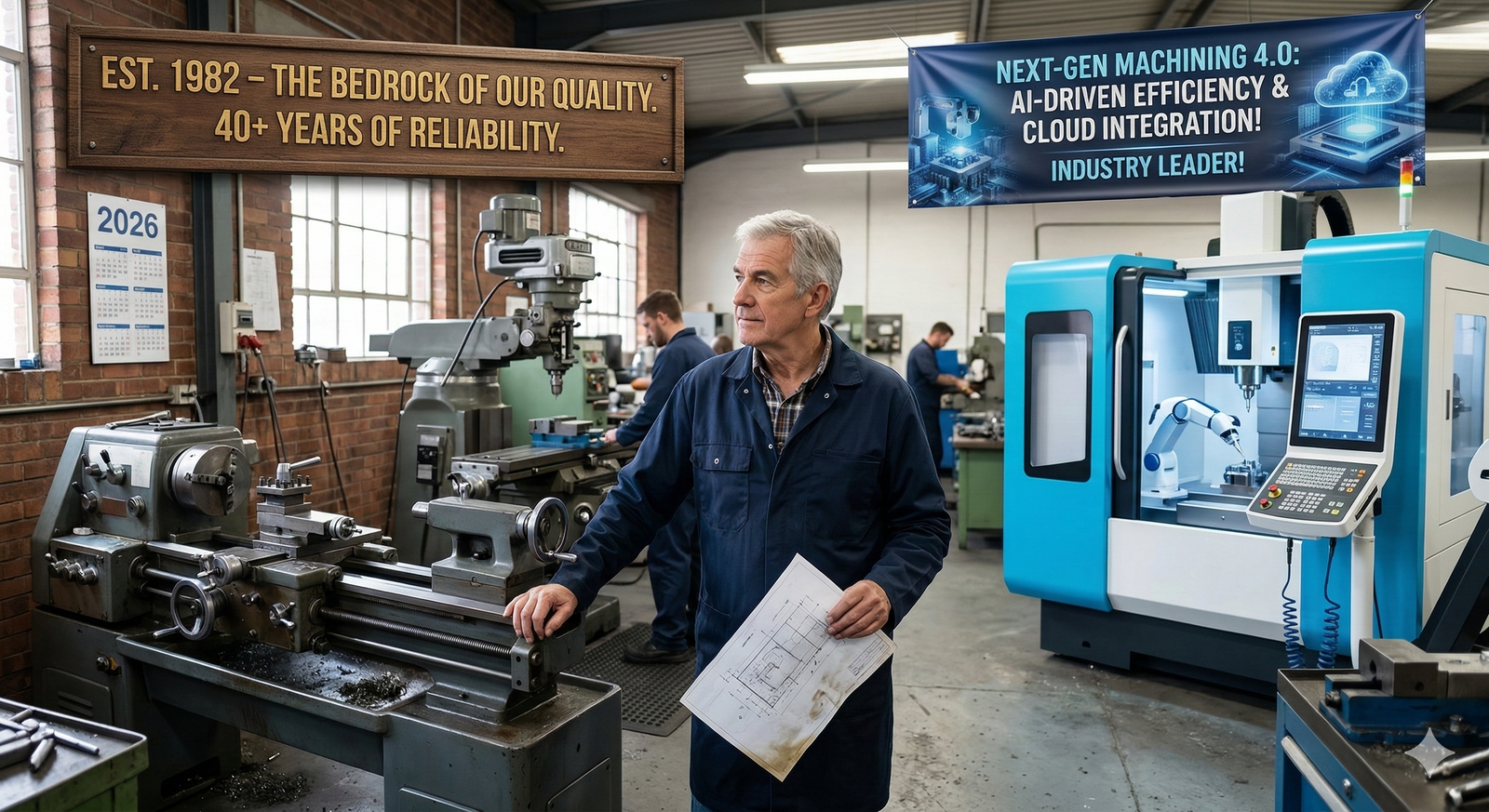

Here is a SEO-ready blog post written in the engineering-first, practical voice that fits STANDARD’s positioning and highlights your 40-year heritage (1982–2026) as a trust signal for manufacturers. It aligns with your strategy of presenting STANDARD as a reliable manufacturing partner rather than a hype-driven machine seller.
Heritage vs. Hype
Why a 40-Year Legacy in Machine Tools Is the Best Insurance for a Modern Shop (1982–2026)
In the machine tool industry, trends come and go.
Every few years a new brand appears promising faster machines, revolutionary designs, or unbeatable prices. Marketing language becomes more aggressive, brochures grow thicker, and claims become louder.
But experienced manufacturers know something important:
Machines are not purchased for marketing claims.
They are purchased for decades of production.
That is why many of the most successful machine shops evaluate suppliers through a simple question:
Will this company still be supporting this machine ten years from now?
In an industry where reliability, parts availability, and service support matter as much as the machine itself, heritage often matters more than hype.
Why Longevity Matters in the Machine Tool Industry
Unlike many products, machine tools are long-term investments.
A CNC machine purchased today is often expected to run reliably for 10–20 years or more.
During that time, the shop will depend on the supplier for:
-
- spare parts
- technical documentation
- service support
- software updates
- application advice
If the supplier disappears or fails to support the equipment properly, the consequences can be serious.
Production downtime, expensive retrofits, or premature machine replacement can quickly erase any short-term savings.
This is why experienced buyers look carefully at the track record of the company behind the machine.
What a 40-Year Legacy Actually Represents
A company that has been active in the machine tool industry for decades has likely faced — and solved — many challenges.
Over time, a long-standing company accumulates:
Practical Engineering Experience
Years of exposure to real manufacturing environments lead to better understanding of:
-
- machining stability
- machine rigidity
- serviceability
- process integration
Machines improve as experience accumulates.
Proven Supply Chains
Reliable machine suppliers develop long-term relationships with manufacturing partners, component suppliers, and service providers.
These relationships help ensure:
-
- consistent machine quality
- reliable spare parts availability
- stable production processes
Stronger Support Systems
Supporting machines in the field for decades forces companies to develop better service systems.
This includes:
-
- clear documentation
- spare parts mapping
- service networks
- troubleshooting procedures
Over time, these systems become a major advantage for customers.
The Problem With “Hype-Driven” Machine Sales
In contrast, some machine suppliers focus heavily on aggressive marketing.
Their messaging often emphasizes:
-
- extremely low pricing
- exaggerated performance claims
- vague descriptions of machine capability
But marketing language cannot compensate for weak engineering or poor support infrastructure.
Shops that purchase machines based only on price often encounter challenges such as:
-
- limited documentation
- slow parts availability
- unclear service responsibility
- inconsistent machine performance
These issues rarely appear in the sales brochure — but they can become very real once the machine enters production.
Why Experienced Shops Look Beyond Price
Machine tool purchasing decisions are often influenced by the long-term economics of production.
A slightly lower purchase price rarely matters if the machine later causes:
-
- production downtime
- unstable machining processes
- expensive maintenance issues
Experienced manufacturers often focus instead on total lifecycle value, which includes:
-
- machine reliability
- long-term service support
- parts availability
- technical guidance
In many cases, the machine supplier becomes a long-term partner in the shop’s success.
The Value of Industry Experience
Companies that remain active in the machine tool industry for decades tend to share several characteristics.
They have learned to prioritize:
Reliability Over Trends
Machines must perform consistently in real production environments.
Marketing trends come and go, but machining stability remains essential.
Honest Communication
Experienced suppliers understand the importance of discussing:
-
- machine limitations
- process requirements
- realistic production capabilities
This level of transparency builds long-term trust.
Long-Term Customer Relationships
In the machine tool industry, reputation compounds over time.
Suppliers who support customers well often develop relationships that last across multiple machine purchases.
Why Heritage Still Matters in 2026
Manufacturing technology continues to evolve rapidly.
Modern machines now incorporate:
-
- advanced CNC controls
- digital monitoring systems
- automation interfaces
- improved machining dynamics
But despite these technological advances, the fundamentals of machining remain the same.
Machines must still provide:
-
- rigidity
- stability
- precision
- reliability
Companies that have spent decades working with these fundamentals often develop deeper insight into what truly matters on the shop floor.
The Best Combination: Experience and Modern Engineering
The most successful machine tool companies combine two strengths:
long industry experience
and
modern manufacturing technology
This combination allows them to deliver machines that benefit from both:
-
- proven engineering knowledge
- modern machining capabilities
For manufacturers, this provides confidence that new equipment will perform reliably not only today, but for many years into the future.
Choosing a Machine Supplier Is a Long-Term Decision
Purchasing a machine tool is not just about selecting equipment.
It is about choosing a partner that will support that machine throughout its lifecycle.
Manufacturers should consider questions such as:
-
- How long has this company been active in the industry?
- Do they understand real machining processes?
- Will they still be supporting this machine years from now?
- Do they prioritize long-term relationships or short-term sales?
The answers to these questions often reveal more about a supplier than any marketing brochure.
Final Thoughts
In an industry built on precision, reliability, and long-term investment, reputation matters.
Marketing claims may attract attention, but long-term industry experience builds trust.
A company that has spent decades working alongside manufacturers understands the realities of machining — the challenges, the risks, and the importance of dependable equipment.
Because when a machine becomes part of a shop’s production process, the goal is simple:
It must work — reliably, consistently, and for years to come.
And in manufacturing, few things provide more confidence than a legacy built through decades of real machines running in real shops.



Leave a comment (all fields required)