

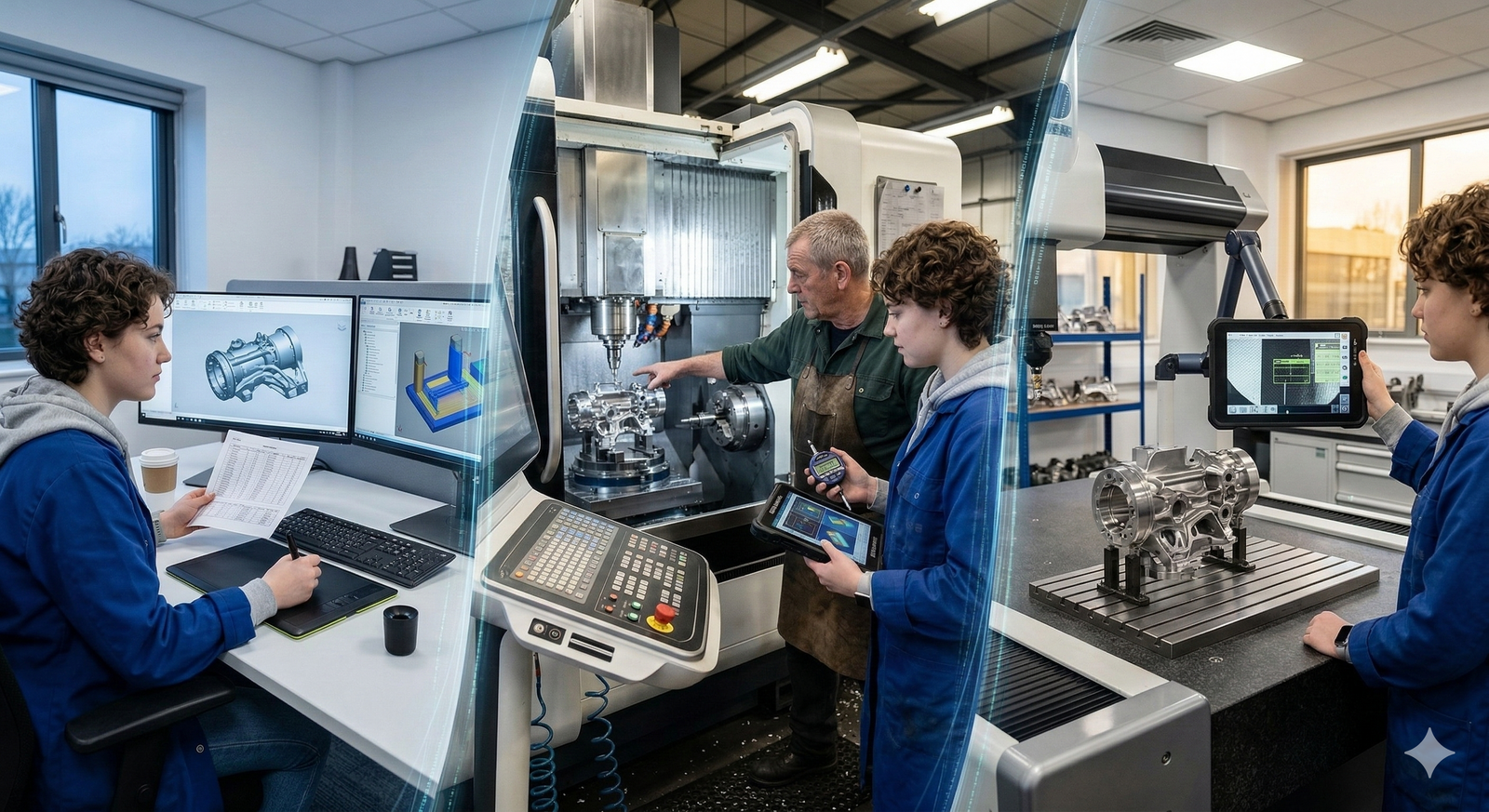

How Modern Machinists Combine Software, Machines, and Real-World Problem Solving
Manufacturing has changed dramatically over the past two decades.
While traditional machining skills remain essential, today's machinists increasingly combine hands-on machining expertise with digital manufacturing tools.
This new generation of professionals is often called the Digital Machinist.
They operate CNC machines, program toolpaths, analyze machining processes, and solve production problems using both experience and technology.
But what does a typical day actually look like for someone in this role?
Let’s step inside a modern machine shop.
6:30 AM – Reviewing the Production Plan
The day often starts before machines even begin cutting metal.
The Digital Machinist reviews:
-
- production schedules
- job priorities
- machine availability
- tooling requirements
In many shops, this information is accessed through digital production systems or job management software.
If a new part is scheduled to run, the machinist may begin reviewing:
-
- part drawings
- CAD models
- tolerance requirements
- surface finish specifications
Understanding the process requirements early helps prevent problems later.
7:15 AM – CAM Programming and Toolpath Strategy
Before a machine begins cutting a new job, the machining process must be programmed.
Using CAM software such as:
-
- SolidCAM
- Mastercam
- Edgecam
- Esprit
the Digital Machinist creates toolpaths that define how the machine will remove material.
Key considerations include:
-
- roughing strategies
- finishing passes
- stepovers and stepdowns
- tool engagement angles
- chip evacuation
Modern CAM systems allow machinists to simulate the entire process before the machine even starts.
This simulation helps detect:
-
- collisions
- inefficient toolpaths
- fixture interference
By catching issues digitally, the shop avoids costly mistakes on the machine.
8:30 AM – Machine Setup
Once the program is ready, attention shifts to the machine.
Machine setup typically involves:
-
- installing cutting tools
- setting tool lengths and offsets
- mounting fixtures or vises
- loading the CNC program
- verifying work offsets
For complex parts, setup can be just as important as programming.
A stable setup ensures:
-
- dimensional accuracy
- repeatable production
- safe machining conditions
Experienced machinists know that a well-designed setup prevents half the problems that occur later.
9:30 AM – First Article Machining
The first part produced from a new setup is known as the first article.
This stage requires careful attention.
The machinist monitors:
-
- spindle load
- cutting sound
- chip formation
- vibration levels
Even with digital simulation, real-world cutting conditions sometimes behave differently than expected.
Small adjustments may be required, such as:
-
- feed rate changes
- toolpath adjustments
- coolant flow modifications
Once the first part is complete, it is inspected to confirm that it meets all dimensional requirements.
11:00 AM – Process Optimization
After the first article passes inspection, production begins.
But the Digital Machinist rarely considers the job finished.
Instead, they often begin looking for ways to improve the process.
Possible improvements include:
-
- reducing cycle time
- improving surface finish
- extending tool life
- improving chip evacuation
Even small improvements can significantly impact productivity when hundreds or thousands of parts are produced.
12:00 PM – Problem Solving
No production environment is perfect.
Machines occasionally stop, tools wear unexpectedly, or material behaves differently than expected.
When problems arise, the Digital Machinist becomes a production problem solver.
Typical issues may include:
-
- tool chatter
- broken cutters
- dimensional drift
- poor surface finish
Solving these problems requires both analytical thinking and machining experience.
Sometimes the solution involves:
-
- adjusting toolpaths
- changing tooling
- modifying cutting parameters
- improving fixturing
This is where the combination of digital knowledge and practical machining skill becomes extremely valuable.
2:00 PM – Inspecting Production Parts
Quality control remains a critical part of machining.
Digital machinists often work closely with inspection systems such as:
-
- coordinate measuring machines (CMM)
- digital micrometers
- probing systems
- optical inspection tools
These systems ensure parts meet required tolerances and help detect issues early.
Modern CNC machines may also include in-process probing, allowing parts to be measured directly on the machine.
3:00 PM – Planning the Next Job
As the day progresses, the machinist may begin preparing for upcoming work.
This might involve:
-
- reviewing new drawings
- selecting tooling
- creating CAM programs
- planning fixturing strategies
This preparation ensures that the next job can begin smoothly.
Shops that plan ahead reduce downtime and keep machines productive.
4:00 PM – Continuous Learning
One defining characteristic of Digital Machinists is their commitment to continuous learning.
Many spend time each week:
-
- watching machining demonstrations
- reading technical forums
- testing new tooling strategies
- learning advanced CAM features
Manufacturing technology continues to evolve, and machinists who stay current gain a major advantage.
The Value of the Digital Machinist
Modern manufacturing depends on individuals who can combine:
-
- mechanical intuition
- machining skill
- software knowledge
- process thinking
The Digital Machinist is not just an operator.
They are often:
-
- programmer
- setup specialist
- process engineer
- production problem solver
Their ability to bridge traditional machining knowledge with modern digital tools makes them one of the most valuable people in any modern machine shop.
Why This Matters for the Future of Manufacturing
As experienced machinists retire, manufacturers must develop a new generation of professionals who can carry forward both technical knowledge and modern manufacturing skills.
The Digital Machinist represents that future.
By combining practical experience with advanced digital tools, these professionals help manufacturers produce better parts, reduce downtime, and improve efficiency.
Manufacturing may be evolving rapidly, but at its core it still relies on skilled people who understand both machines and the materials they shape.
And that is exactly what the Digital Machinist does.



Leave a comment (all fields required)